

The short answer
Cloth, woven chambray, vegan leather, real leather or hard plastic: what each mouse pad surface is actually like to use, scored on glide, control, cleaning and how it ages.
Short answer: for everyday desk work, a smooth vegan-leather top gives the most consistent tracking and wipes clean in a second. A woven fabric top gives a little more braking under the mouse, and has to be spot-cleaned instead. Hard plastic and glass tops are fast but noisy and unforgiving. There is no best material in the abstract, only the one that matches your desk, your mouse and how messy your tea gets.
Most people buy a mouse pad once, by the picture, and then live with it for three years. The surface under your hand decides how the cursor behaves, how loud the desk is, how the pad looks after a hundred coffees, and whether the thing stays put when you shove it. It is worth two minutes to know what each material actually does.
Below are the five surfaces you will realistically be choosing between in India, scored honestly, including where ours lose. If you already know you want a round one, our round mouse pads come in both of the surfaces that win here.
The five mouse pad materials, scored
Green is strong, amber is average, red is weak.
| Material | Glide | Control | Cleaning | Ages well | Typical thickness |
|---|---|---|---|---|---|
| Cloth over foam | Medium | High | Wash and dry | Frays, stains | 3–5 mm |
| Woven chambray | Medium | High | Spot-clean only | Softens, holds shape | 1.3 mm |
| PU vegan leather | Smooth | Medium | Wipes clean | Holds colour | 1.3 mm |
| Genuine leather | Smooth | Medium | Conditioner | Patinas | 2–4 mm |
| Hard plastic or glass | Fastest | Low | Wipes clean | Scratches | 2–4 mm |
What each material is actually like to use
Cloth over foam is the default pad everyone has owned. The soft weave brakes the mouse nicely, which is why low-sensitivity gamers still swear by it. The catch is the foam: it compresses unevenly, the stitched edge frays, and any spill soaks straight through. Most cloth pads are a two-year item, not a ten-year one.
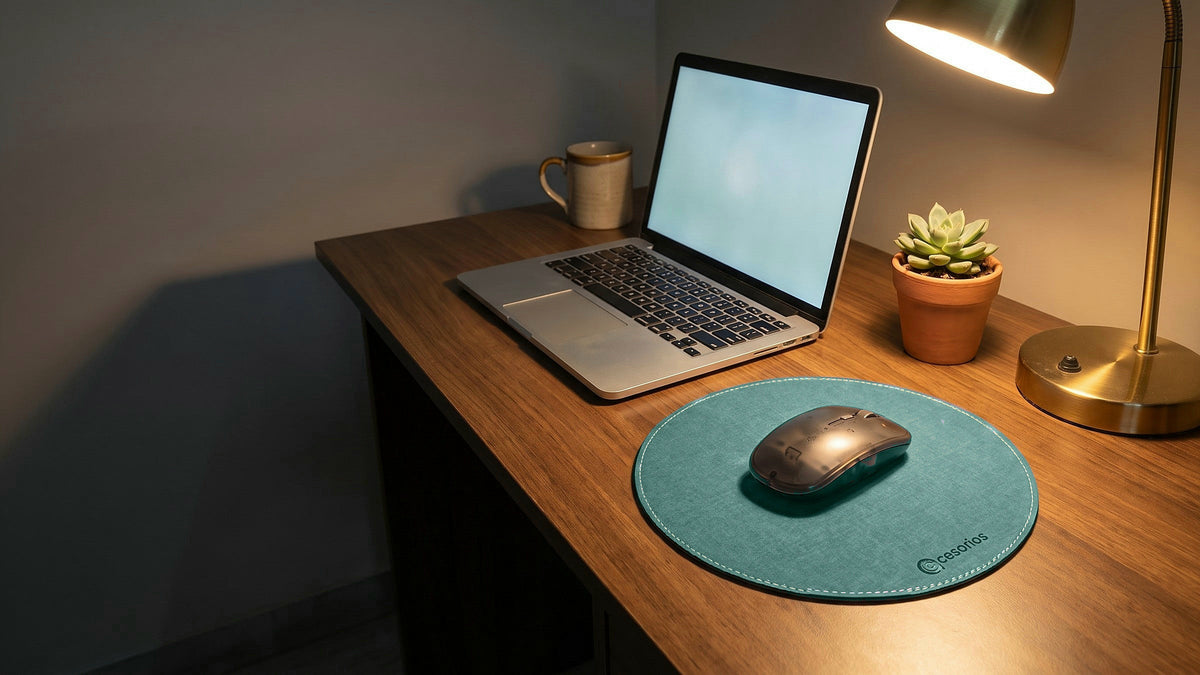
Woven chambray is the same idea done as a flat woven fabric with no foam sandwich. You keep the fabric feel and the extra control, and because there is no foam the pad stays 1.3 mm flat and never develops a dent where your wrist sits. The honest downside: it is fabric. Chai will soak in. You blot it and spot-clean it, you do not wipe it. Our Ash Grey and Sage Green pads are this surface, at ₹599.
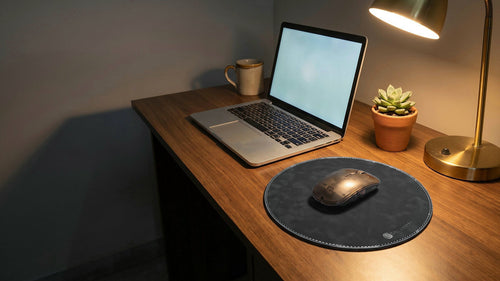
PU vegan leather is the one most people end up happiest with for office work. It is smooth rather than fast, so the cursor goes where you put it without skating, and it is the only soft surface here you can genuinely wipe. Spill something and it sits on top until you take a cloth to it. It is also the cheapest of the long-lived options. Our Royal Blue, Slate Charcoal and Stone Grey pads use it, at ₹499. Its weakness is that a hard scrape from a ring or a watch buckle will mark the top coat, and that mark does not buff out.

Genuine leather ages better than anything else on the list and feels excellent, but it costs several times what any of the others do, it wants occasional conditioning, and it darkens unevenly where your palm rests. It is a lovely object and a poor value calculation.
Hard plastic and glass tops are the fastest surfaces made. Competitive players who want minimum friction use them. For everyday work they are a bad fit: they are loud, they chew through mouse feet, they are cold in winter and clammy in humidity, and the tiniest grit under the mouse scratches a permanent line across them.
Do you need a rubber base?
Almost every pad sold has a moulded rubber underside, and almost every buyer assumes that is the only way to stop a pad sliding. It is not. Rubber is what forces a pad to be 3 mm or thicker, and thick rubber is what curls at the corners after a year in a warm room.
Our pads have no rubber base at all. The underside is a tan grip layer bonded to the top, which is why the whole pad is 1.3 mm thick — a little under twice a credit card — and still does not travel across the desk. Thin also means it does not sit proud of the desk edge under your forearm, and it slides flat into a laptop sleeve.
The trade-off is real and worth stating: on a very smooth surface with nothing else on it, a heavy rubber pad will resist a hard shove slightly better than a thin grip layer will. If you play at low sensitivity and swipe the mouse the full width of the desk, buy the rubber.

Which material suits which desk
- Wooden and laminate desks. Anything works. Pick on cleaning and looks, not grip — these surfaces have enough texture to hold any pad.
- Glass desks. This is where pads fail. A glass top is slippery, so a light pad wanders, and an optical sensor on bare glass does not track at all. You want either a heavy rubber-backed pad or a thin pad with a proper grip underside. Avoid hard plastic and glass tops here, because plastic on glass is the worst combination for sliding.
- Fabric-topped and laminated office desks. Grip is not the problem; flatness is. A foam pad on a slightly soft desk top gives a spongy feel under the wrist. A thin, firm pad is better.
- Standing desks. You shift position more, so the pad gets nudged more. Thin plus grippy beats thick plus heavy, because a thick pad's edge digs into your forearm at standing height.
- Shared or hot desks. Wipe-clean wins outright. A fabric pad that lives on a shared desk will look its age within months.

So which should you pick?
- Office work, tea at the desk, want it to last: PU vegan leather. Smooth, wipes clean, ₹499.
- You like a softer, grippier feel and keep your desk dry: woven chambray at ₹599.
- You play at low sensitivity and swipe wide: a large cloth-over-foam pad, and accept that you will replace it.
- You want the fastest possible surface and do not mind the noise: hard plastic or glass.
- You want an object rather than a tool: genuine leather, at four times the money.
If you are not sure what size you need before you pick a surface, our mouse pad size guide has the full chart in centimetres and inches, plus a 30-second way to measure your own desk.
See both surfaces and all five colours on our round mouse pads page — 23 cm across, 1.3 mm thin, made in India. We also make wallet flip covers in denim and chambray.
Frequently asked questions
What material is best for a mouse pad?
For everyday desk work, PU vegan leather. It tracks consistently, wipes clean after a spill, and holds its colour for years. Woven fabric is the better pick if you prefer a grippier feel and keep the desk dry. Hard plastic and glass are faster but louder and harsher on mouse feet, and genuine leather costs three to four times as much for no gain in tracking.
Is a leather mouse pad better than a cloth one?
They are better at different things. Leather and vegan leather are smoother, so the cursor travels more evenly and stops where you aim. Cloth has more friction, which helps if you move the mouse in big sweeps at low sensitivity. On cleaning it is not close: leather and vegan leather wipe, cloth absorbs.
Can you wipe a mouse pad clean?
Only if the top is vegan leather, genuine leather, plastic or glass. Our Royal Blue, Slate Charcoal and Stone Grey pads are vegan leather and wipe with a damp cloth. Our Ash Grey and Sage Green pads are woven chambray, which is fabric — those are blotted and spot-cleaned with a little mild soap, never soaked, and never claimed to be waterproof.
Does a mouse pad need a rubber base to stay put?
No. Rubber is the common way to stop a pad sliding, not the only one. A bonded grip underside holds a thin pad in place on wood, laminate and glass without the 3 mm of rubber that makes a pad curl at the corners. Rubber still has the edge if you swipe the mouse very hard across a large pad.
Is vegan leather the same as real leather?
No. Vegan leather here means polyurethane on a fabric backing. It looks and feels close to finished leather, costs far less, contains no animal product, and does not need conditioning. What it will not do is develop the patina real leather does, and a deep scratch in the top coat is permanent.
How thick should a mouse pad be?
Thinner than most people expect. Anything from about 1 mm to 3 mm keeps your wrist close to the natural desk height. Ours are 1.3 mm. Pads of 4 mm and up add a soft foam layer that some people like for wrist comfort, but that layer compresses unevenly over time and makes the pad harder to carry flat.
Pick your surface
Five round mouse pads, 23 cm across and 1.3 mm thin — three in marbled vegan leather, two in woven chambray. Made in India.
Shop mouse pads

Get the next guide first
Care tips and buying guides for your phone — no spam.